
This article is written for general medical education and public health information. It explains the background of a recent regulatory milestone for an investigational cell therapy. It does not constitute medical advice, diagnosis, or a treatment recommendation. Treatment decisions should always be made with a qualified physician based on individual circumstances.
What the IND Approval Means
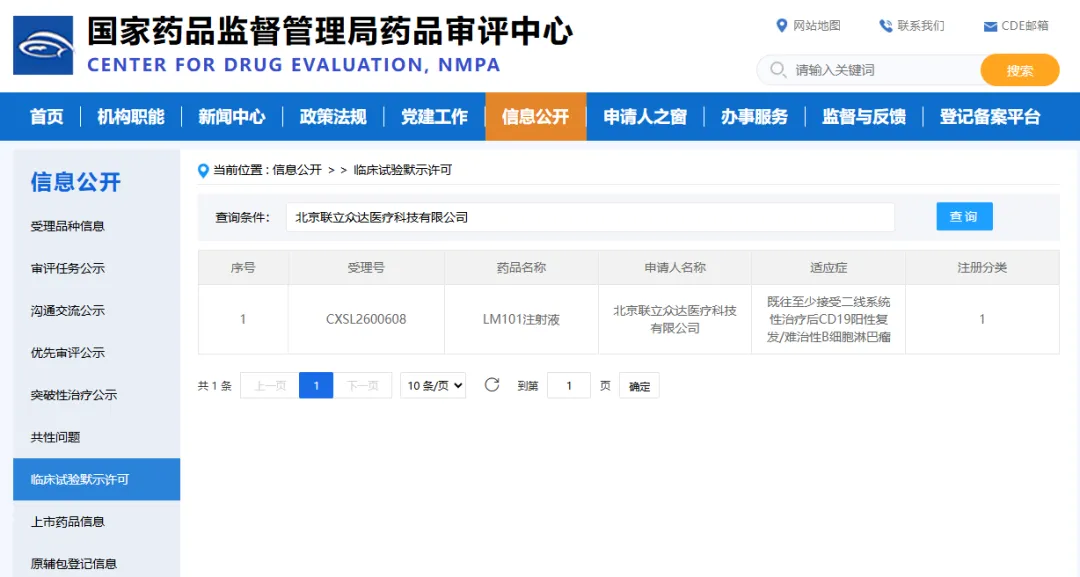
In August 2026, the Center for Drug Evaluation (CDE) of China's National Medical Products Administration approved an Investigational New Drug (IND) application for LM101 injection, a CD19-directed autologous CAR-T cell therapy. The application number is CXSL2600608, and the product is classified as a Class 1 innovative biologic.
IND approval is not a marketing authorization. It allows the sponsor to begin a regulated clinical trial in China. The planned study will focus on adults with CD19-positive relapsed or refractory B-cell lymphoma who have received at least two prior lines of systemic therapy. This patient group often has limited remaining standard options, which is why newer cellular therapies are being investigated.
What Is CAR-T, and What Makes LM101 Different?
CAR-T (chimeric antigen receptor T-cell) therapy is a form of cellular immunotherapy. A patient's own T cells are collected, genetically modified in a laboratory to recognize a specific marker on cancer cells, expanded into larger numbers, and then infused back into the patient. The modified T cells can then seek out and attack cancer cells displaying that marker.
For B-cell lymphomas, CD19 is the most commonly used target because it is present on most malignant B cells. Several CD19 CAR-T products are already approved globally and in China for relapsed/refractory B-cell lymphomas and leukemias.
According to the developer, LM101 was engineered with a second chimeric receptor intended to counter immune suppression within the tumor microenvironment. The idea is to help the CAR-T cells remain active even when the tumor environment sends inhibitory signals — a known challenge that can limit how long CAR-T cells stay effective. Whether this structural difference translates into meaningful clinical benefit will need to be confirmed in controlled clinical trials.
Prior Investigator-Initiated Trial Data
Before the IND, LM101 was studied in investigator-initiated trials (IITs) at Peking University Cancer Hospital. These early-phase studies enrolled more than 30 patients with relapsed/refractory CD19-positive B-cell lymphoma.
The reported findings from the higher-dose phase Ib cohort included:
- Objective response rate (ORR) of approximately 87%
- Complete response (CR) rate of approximately 70%
- No grade 3 or higher cytokine release syndrome (CRS) observed among enrolled patients
These are early-phase results, not the kind of randomized evidence used for formal approval. They are useful for understanding the therapy's potential, but response rates from single-arm early studies can be higher than what is seen in broader, controlled trials. The ongoing IND-sponsored study will be important for confirming efficacy, refining safety expectations, and defining the appropriate patient population.
The Clinical Setting: Relapsed/Refractory B-Cell Lymphoma
B-cell lymphomas are a diverse group of blood cancers. Many patients respond well to first-line chemoimmunotherapy, but a subset experience relapse after initial treatment or never achieve a durable remission. When disease returns after two or more lines of therapy, it is described as relapsed/refractory, and treatment options become more limited.
CAR-T therapies have changed the outlook for some of these patients. They are not suitable for everyone — eligibility depends on factors such as organ function, prior therapies, infection status, and overall fitness — but they represent an important therapeutic category in modern lymphoma care.
What Happens Next?
With IND approval, the next step is a regulated clinical trial conducted under CDE oversight. Such trials typically evaluate safety, optimal dosing, manufacturing consistency, and efficacy outcomes in a defined patient population. The results will determine whether LM101 can eventually advance toward a marketing application in China.
More broadly, the development reflects continued growth in China's cell-therapy pipeline, with increasing numbers of domestic CAR-T products entering clinical testing for hematologic cancers and, increasingly, for solid tumors.
Key Takeaways
- IND approval is a trial-start milestone, not a market launch. It allows regulated clinical testing to begin.
- LM101 is a CD19-directed autologous CAR-T product with an added structural element designed to address tumor-microenvironment suppression.
- The target population is CD19-positive relapsed/refractory B-cell lymphoma after at least two prior systemic therapies.
- Early-phase data are promising but preliminary. Reported ORR and CR rates need confirmation in larger, controlled studies.
- Suitability for CAR-T must be determined individually by an experienced hematology team.
Medical Disclaimer
This article is provided for general medical education and public health information only. It does not constitute medical advice, diagnosis, or treatment recommendations. Clinical trial data, regulatory status, and prescribing information change over time; always consult a licensed healthcare professional for personal medical decisions.